
New here? Find a practical guide for your wardrobe →
Sunglasses attract more rules than most accessories: square frames for round faces, aviators for everyone, never match the brow, always match the brow. Most of this advice starts too late. A frame must first protect the eyes, sit correctly and match the scale of the wearer. Shape becomes useful only after those basics are solved.
Protection is the first filter
Look for lenses clearly marked to block 99 to 100 percent of UVA and UVB radiation, or labelled UV400. Both the American Optometric Association and the US National Eye Institute emphasise this level of protection. A dark tint alone is not proof of UV performance, and price is not a reliable substitute for the label.
Polarisation is a separate feature. It reduces glare reflected from roads or water and can be valuable for driving or travel, but it does not automatically guarantee UV protection. Check for both claims when both matter.
Large lenses and close-fitting frames can reduce light entering around the sides. That does not require a sport wraparound in every context; a well-proportioned panto or rectangular frame can offer useful coverage without overwhelming the face.
Start at the bridge
The bridge determines whether the frame belongs on the face or merely rests there. It should make stable contact without pinching and without allowing the glasses to slide down whenever the head moves. The lower edge of the frame should not sit heavily on the cheeks or lift when smiling.
Low, high and keyhole bridges distribute weight differently. There is no universally superior style. Try frames long enough to notice pressure, not just long enough to take a mirror photograph. If the bridge is wrong, changing lens shape will not rescue the fit.
The temples should travel straight back without bowing dramatically outward. Their tips should curve behind the ears without creating a pressure point. An optician can make small adjustments, but a fundamentally narrow or wide frame is better replaced than forced.
Match frame scale to feature scale
Instead of diagnosing a face as a perfect geometric shape, compare the frame with three visible references: the width of the face, the strength of the brow and the length of the nose. A frame close to the face’s width usually looks settled. Slightly wider can feel relaxed; distinctly narrower can look pinched.
Fine features are often complemented by a thinner rim and restrained bridge. Strong brows, a broader jaw or substantial hair can carry more material. This is a balance, not a correction. The goal is not to disguise a face but to keep the accessory from appearing accidentally large or small.
Use shape for tension
Once the scale is right, shape can create contrast. A softly angular frame adds definition to rounded features. A panto or gently curved rectangle can soften a very linear face. Perfect opposition is not required; a square face can look excellent in a square frame when the corners, thickness and colour are handled well.
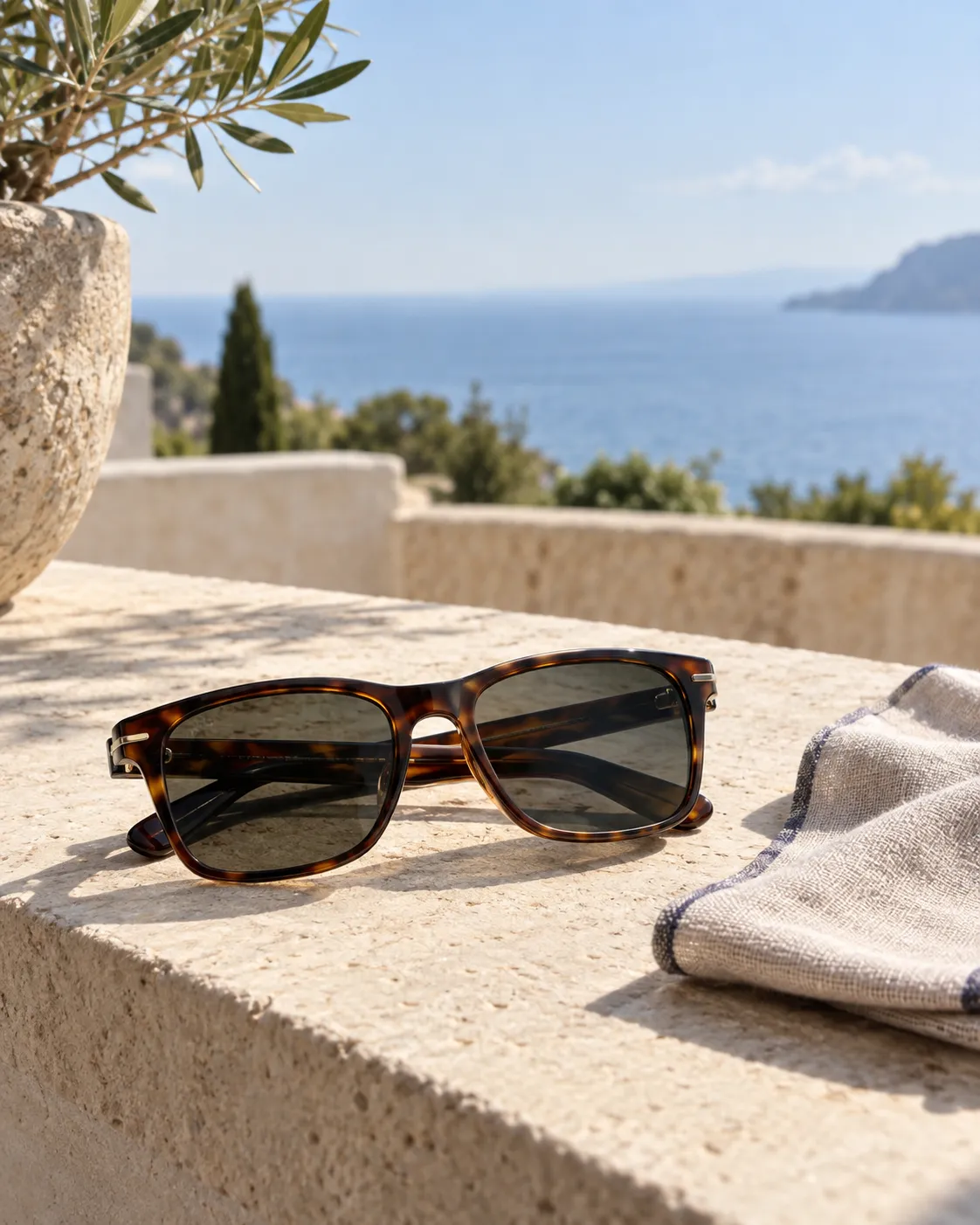
Medium rectangular frames are an adaptable starting point because they sit between severe geometry and full roundness. Dark tortoiseshell is softer than solid black while still working with navy, olive, cream and grey. Smoke, bottle green and brown lenses tend to integrate with a muted wardrobe more easily than mirrored colours.
Test them with actual clothes
Wear the frame with a T-shirt, an open-collar shirt and an outer layer. A pair that seems dramatic in isolation may become balanced beneath a jacket collar; a delicate wire frame may disappear when worn with a heavy coat. Check the view from the side as well as the front, because temple thickness and lens angle change the silhouette.
Good sunglasses combine health equipment with personal style. Put verified protection and physical fit first, then choose the amount of character. That order produces a pair worth wearing long after the current frame trend has moved on.
Sources
- Ultraviolet Protection — American Optometric Association
- Protecting Your Eyes from the Sun's UV Light — National Eye Institute
Build your next outfit
Start with our 12-piece smart-casual wardrobe checklist.
Follow the journal on Substack for more outfit formulas and practical style guides.