
New here? Find a practical guide for your wardrobe →
A brooch is a very small object with an unusually large effect. It interrupts the predictable geometry of a jacket—lapel, shirt, pocket square, buttons—and gives the eye a place to stop. That is exactly why it can make a restrained suit feel personal, and why the wrong brooch can make the same outfit feel like costume.
The renewed interest is measurable. Pinterest’s 2026 trend report identifies “Brooched” as an emerging fashion direction and reports strong growth in searches for brooches worn with men’s suits. GQ and Vogue have also documented pins and brooches moving through menswear collections, red carpets and street style. The useful question is no longer whether a man can wear one. It is how to make one belong to the clothes he already owns.
Begin with scale, not sparkle
For a first brooch, choose a piece that fits comfortably inside the width of the lapel. A restrained geometric shape, leaf, flower, knot or abstract metal form is easier to integrate than an oversized crystal composition. Brushed silver, oxidised metal, enamel and dark stones sit naturally against navy, charcoal, brown and black tailoring. They introduce texture without demanding that every other accessory compete.
Scale should follow the jacket. A broad peak lapel can support a slightly larger or more dimensional piece; a narrow notch lapel needs something lighter. The brooch should look deliberate from conversational distance but should not become the only thing visible across a room. If the piece has movement, chains or several articulated parts, simplify everything around it.
Place it high on the left lapel
The traditional starting point is the left lapel, close to the buttonhole and above the chest pocket. This position follows the jacket’s existing architecture and keeps the brooch away from the fold line. Place it too low and it can drag the lapel down; too close to the edge and it may rotate or pull the cloth outward.
Before piercing fine fabric, inspect the fastening and the weight of the piece. A heavy pin can mark delicate worsted wool, cashmere or loosely woven cloth. Use an existing lapel buttonhole where possible, consider a magnetic fastening for vulnerable fabric, and test the piece on an inconspicuous area. The object should sit flat without distorting the roll of the lapel.
Give the brooch one clear role
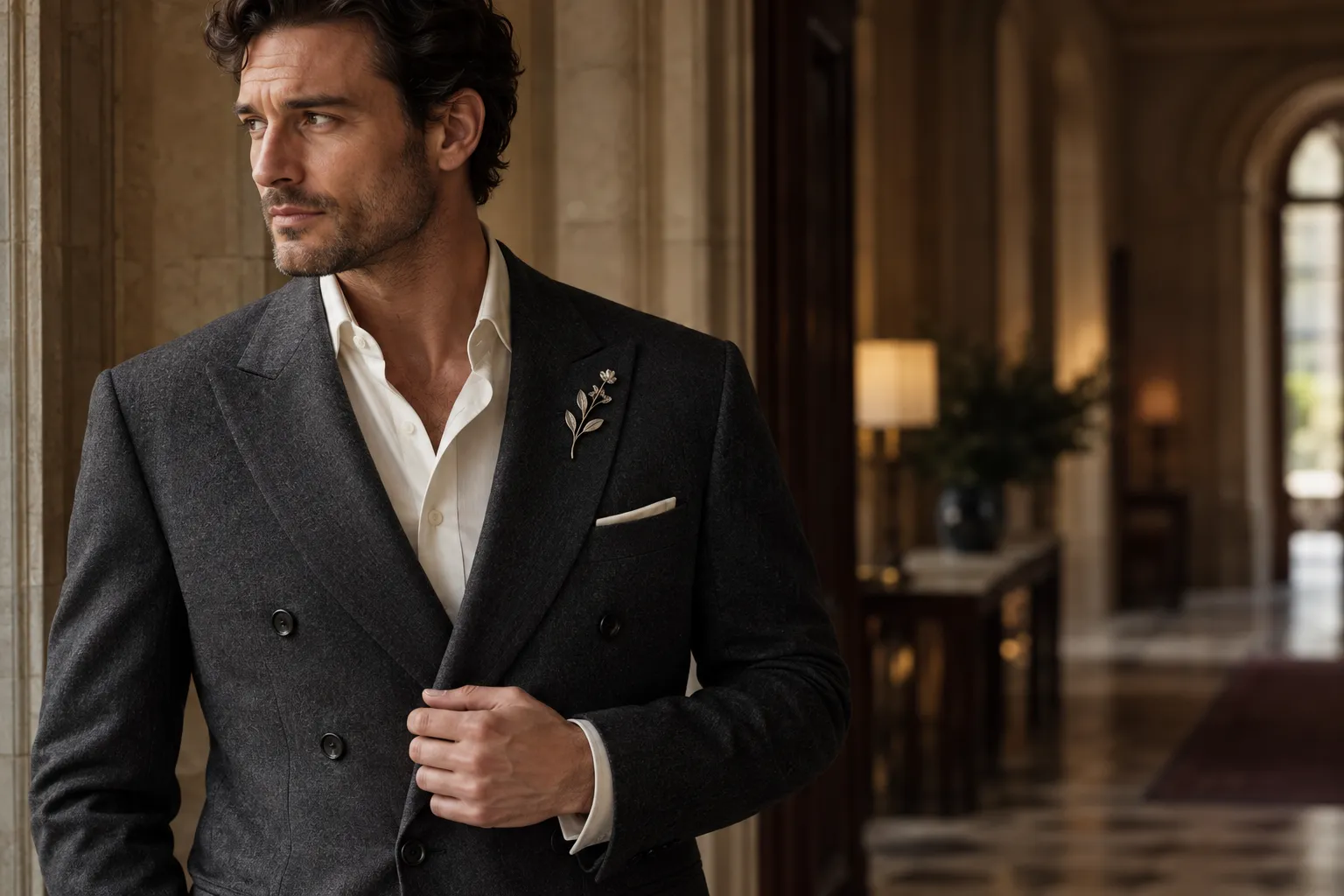
A brooch works best when it is the principal decorative element. With a silver botanical pin on a charcoal suit, choose a plain white or pale-blue shirt and a quiet pocket square. If the brooch contains colour, repeat only one of its tones elsewhere—perhaps in the sock, knit or shirt stripe—rather than building a fully matched set.
Avoid stacking a large brooch, patterned tie, bright pocket square, collar bar and statement watch in one outfit. Each item may be attractive on its own, but together they compete for attention. A useful rule is to remove one conventional accessory when adding the brooch. Skip the pocket square, exchange the patterned tie for a knitted solid, or wear an open collar.
Three outfit formulas that work
For evening tailoring, combine a charcoal double-breasted suit, ivory shirt, black loafers and a small silver brooch. The monochrome base gives the metal enough contrast, while the open collar stops the composition becoming ceremonial. This is the easiest route for dinners, gallery openings and dressed-up social events.
For smart casual, use a navy unstructured blazer, fine-gauge grey crew neck, cream trousers and dark-brown suede loafers. A matte enamel or aged-metal brooch introduces character without looking precious. For a more relaxed version, pin a compact brooch to a substantial wool overshirt or the chest of a chore jacket. Keep the rest of the outfit textural and tonal so the accessory feels collected rather than staged.
Match character to the occasion
Office settings call for a quieter pin than weddings or evening events. Choose a compact metal form with little shine and wear it with familiar business colours. Creative workplaces allow more freedom, but proportion still matters. A playful motif is easier to carry when the jacket, shirt and trousers are disciplined.
Formal events can accommodate brighter stones, floral forms or heirloom pieces because evening light and sharper tailoring already support ornament. Personal history also changes the meaning of a brooch. A family piece, vintage find or small object connected to a place carries more authority than an accessory chosen only because it is trending. If someone asks about it, there should ideally be a better answer than “it matched the suit.”
Build a collection slowly
One versatile brooch is more useful than a drawer of novelty pins. Begin with a neutral metal piece, wear it with three jackets and note where it feels natural. Your second piece can introduce colour or symbolism; a third might be reserved for black tie. This progression reveals your tolerance for scale and ornament before you spend heavily.
Storage matters. Close the pin before putting it away, keep it separate from watches and polished jewellery, and check clasps periodically. Vintage pieces may have sharp or delicate fastenings that deserve professional attention. A brooch should add individuality without damaging the garment beneath it.
The modern brooch is not a replacement for good tailoring. It is punctuation. Begin with a jacket that fits, a coherent palette and a clean trouser line; then add one small object that makes the outfit unmistakably yours.
Sources
Build your next outfit
Start with our 12-piece smart-casual wardrobe checklist.
Follow the journal on Substack for more outfit formulas and practical style guides.