
New here? Find a practical guide for your wardrobe →
A watch can be the same object on Friday evening that it was on Monday morning. The useful question is whether its size, case and strap sit comfortably within all the clothes you actually wear. A clean dial and a case that fits beneath a shirt cuff give you more room to change the outfit around it. The watch need not announce a different dress code every time you leave the house.
This is a styling exercise, not a claim that one model is right for every wrist or occasion. GQ describes dress and sport watches as broad categories with exceptions: dress watches tend to be slimmer and often use leather straps, while sport watches commonly arrive on steel, rubber or fabric. Hodinkee makes the related point that changing a strap can alter a watch’s character. Those observations are a starting point for three outfits, not fixed rules.
1. Tailoring: keep the cuff line clean
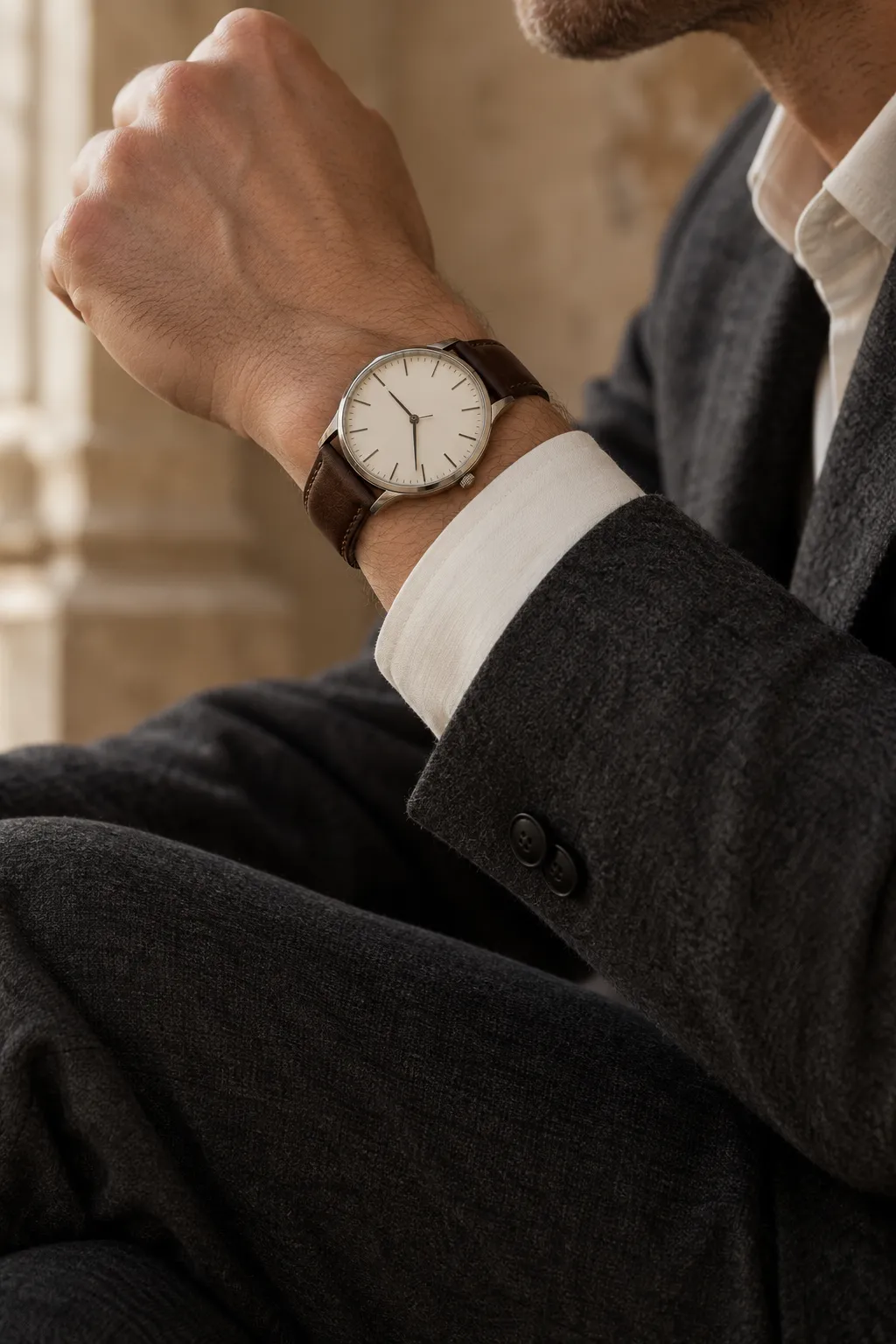
Begin with a charcoal or navy jacket, an off-white shirt and dark trousers. A restrained watch with a simple dial can sit partly beneath the cuff, appearing as the arm moves. The visible details should feel proportionate to the jacket’s lapel and the shirt’s collar. A thick case that catches the sleeve becomes the centre of attention, even when that was not the intention.
Black or dark brown leather is an easy choice here, but metal is not automatically wrong with tailoring. Consider the whole watch rather than judging the strap alone. A quiet steel bracelet can work with relaxed suiting; a large, heavily marked sports case may pull the look in another direction. If the invitation specifies a more formal dress code, choose the most discreet combination in your wardrobe instead of treating a casual watch as universally appropriate.
2. The open-collar workday: repeat one texture
For a less formal office, wear the same watch with an Oxford shirt, an unstructured jacket and straight trousers. The shirt’s visible weave gives a smooth leather strap some contrast. A brushed metal bracelet can also connect with the jacket’s less polished surface. Neither choice requires matching every accessory. Repeating one quality—warmth, sheen or texture—usually makes the combination feel deliberate.
Look at the watch with the sleeve in its normal position. If the cuff covers it completely, that is fine; there is no need to pull the sleeve back for display. If the watch constantly slides over the hand or turns beneath the wrist, adjust its fit before rethinking the entire outfit. A comfortable, stable watch reads more considered than one that needs frequent correction.
3. Weekend clothes: reduce the formality around it
Replace the jacket with a knit polo or a soft overshirt, then add dark denim or relaxed chinos. The same watch can now provide a small point of structure against casual fabrics. Brown leather looks at home with cream knitwear and indigo. Steel offers a cooler edge beside a white tee and navy overshirt. These are outfit formulas, not product claims: the particular dial, case finish and strap condition will change the result.
If the watch allows an interchangeable strap, consider a second strap as a wardrobe tool. Hodinkee notes that a strap change can refresh the appearance of a watch; leather, metal, rubber and fabric have different visual and practical roles. Check the lug width and attachment system before buying anything. Some integrated bracelets cannot be swapped like a conventional spring-bar strap, and a jeweller is the safer choice when the mechanism is unfamiliar.
A five-minute mirror test
Put the watch beside the three outfits before deciding whether it is versatile. First check the case footprint: it should belong on your wrist rather than extending beyond it. Then check the cuff: the sleeve should move naturally. Finally, look at the whole silhouette from a few steps away. If the watch is the first thing you notice in every outfit, decide whether that emphasis is intentional.
There is no requirement to buy three watches for three contexts. Start with the one you own, change the supporting clothes and notice where it feels convincing. If the watch works for two contexts but not the third, that is useful information too. A more appropriate strap—or simply a different outfit—may solve the problem more honestly than a new purchase.
For a closer look at case scale and cuff proportion, read The Case for a Smaller Dress Watch.
Shop the guide
As an Amazon Associate I earn from qualifying purchases.
These are similar style alternatives, not the exact items shown in AI-generated illustrations.
Sources
Build your next outfit
- Timeless Timepieces for the Modern Gentleman
- The Case for a Smaller Dress Watch
- Smart Casual Watch Pairing Formulas
Start with our 12-piece smart-casual wardrobe checklist.
Follow the journal on Substack for more outfit formulas and practical style guides.