
New here? Find a practical guide for your wardrobe →
A grand tourer is not simply a sports car with softer seats. It is a different proposition: performance organised around distance. The best examples feel composed at speed, carry two people and their luggage without apology, and arrive with enough restraint to look appropriate outside a hotel rather than only in a pit lane.
Historical definitions emphasised the same duality. The FIA’s 1971 Appendix J described series-production grand touring cars as machines for drivers seeking the best performance and/or greatest comfort, while Mercedes-Benz’s history of the SL repeatedly joins sport, luxury and long-distance ability. The enduring idea lives in that “and”: pace without punishment, elegance without fragility.
Proportion before aggression
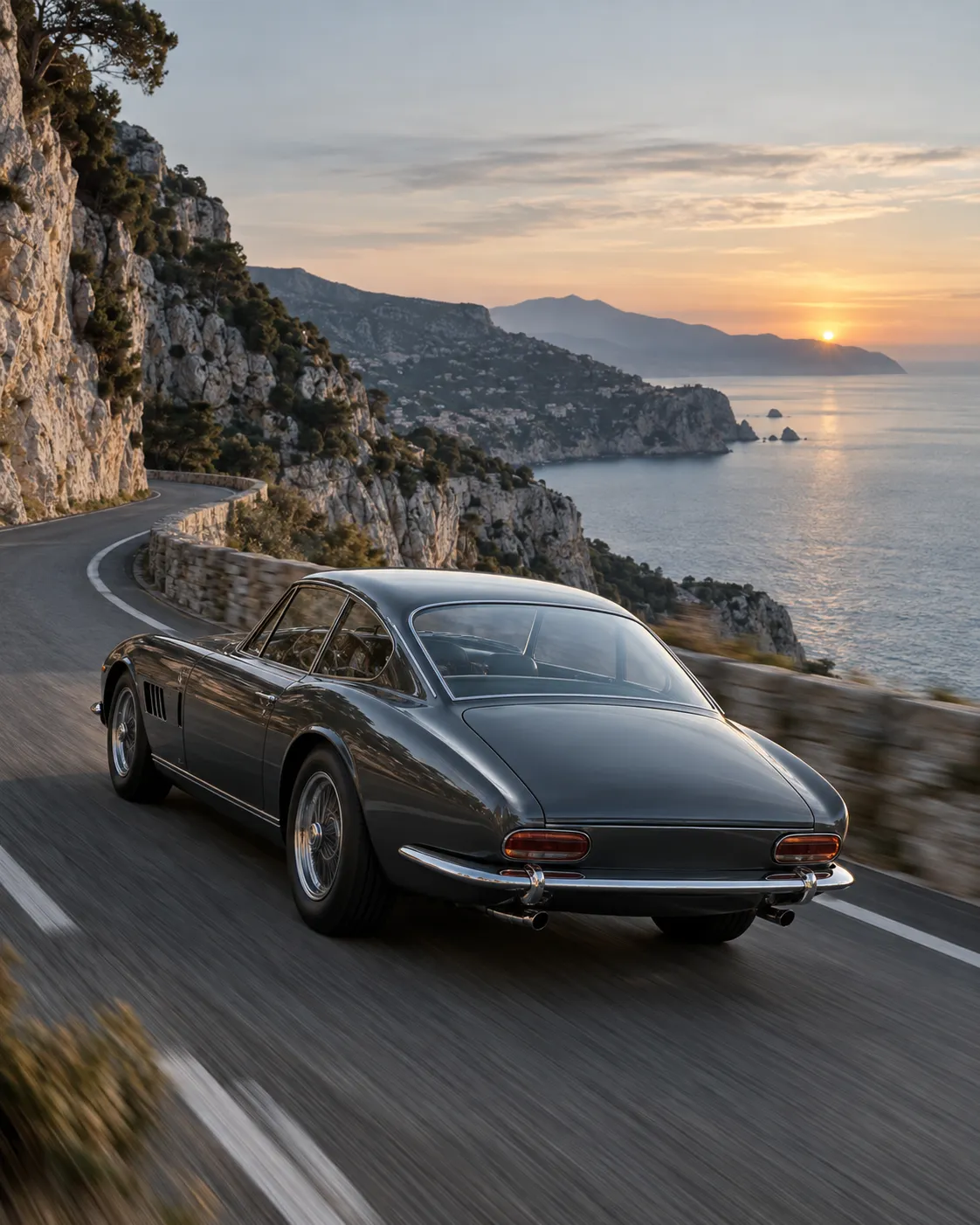
Classic grand tourers often share a visual grammar: a long bonnet, a cabin set slightly rearward, a low roof and enough body behind the seats to imply luggage rather than an engine. The proportions communicate movement before any vent, wing or graphic is added.
This is why restraint matters. A clean body side allows light to describe the volume. A modest grille gives the nose a focal point without turning it into a mask. Wheels fill the arches but retain enough tyre sidewall to suggest real roads. The car looks fast because its mass is organised, not because every surface announces performance.
The lesson applies beyond vintage design. When aerodynamic and cooling requirements produce openings, the best solutions integrate them into the underlying form. Decoration that imitates function ages quickly; an honest intake or carefully resolved shut line tends to survive fashion.
Comfort is a dynamic quality
Grand-touring comfort is not softness in isolation. A heavily cushioned car that floats and needs constant correction can be tiring. The ideal is calm control: a driving position that supports the body, steering that communicates without nervousness, and suspension that absorbs broken surfaces while maintaining a stable platform.
Mercedes-Benz described the 190 SL as offering comprehensive comfort for long journeys at high cruising speeds, and later SL generations continued to combine sportiness with safety and ease. The principle remains relevant even as technology changes. Quiet airflow, predictable controls, clear instruments and usable storage reduce fatigue more effectively than an extravagant list of distractions.
Performance should be accessible
A grand tourer needs reserves, not constant spectacle. Strong mid-range response makes overtaking effortless. Brakes should inspire confidence repeatedly, and the chassis should remain readable when weather or road quality changes. Maximum figures matter less than the ability to deploy performance without preparation.
That accessibility also shapes sound. The engine can have character without droning at a cruise. The exhaust note should mark acceleration, then recede. A car intended for hundreds of kilometres must know when to speak and when to be quiet.
The cabin belongs to the journey
Materials should improve where hands and body meet the car: steering wheel, seat, gear selector, door pull. Glossy surfaces that reflect sunlight or screens that bury basic functions work against the touring brief. Durable leather, cloth, metal and matte finishes can feel luxurious because they are appropriate, not because they are abundant.
Two excellent seats are essential; occasional rear seats can be useful for coats or short trips, but they should not distort the roofline. Luggage capacity need not be enormous. It needs to accept two considered bags without turning packing into engineering.
A mindset, not a badge
The grand-touring ideal can appear in a coupé, roadster or even a well-resolved saloon. It is not guaranteed by a GT badge, cylinder count or price. Ask instead whether the car becomes more satisfying as the road lengthens. Does it settle into speed? Can the driver see, reach and understand what matters? Does its design remain coherent when parked?
The finest grand tourers make distance feel civilised. They do not remove the road; they edit its fatigue and preserve its pleasure. That balance is why the category continues to carry cultural weight long after its racing regulations and body styles have changed.
Sources
- 70 Years of Sport, Luxury and Lifestyle: The Mercedes-Benz SL — Mercedes-Benz Media
- FIA Historic Appendix J — Grand Touring Cars — Fédération Internationale de l'Automobile
Build your next outfit
- Smart Casual Watch Pairing Formulas
- The Sporty-Chic Formula
- Smart Casual Made Simple: Waxed Canvas Jackets
Start with our 12-piece smart-casual wardrobe checklist.
Follow the journal on Substack for more outfit formulas and practical style guides.